
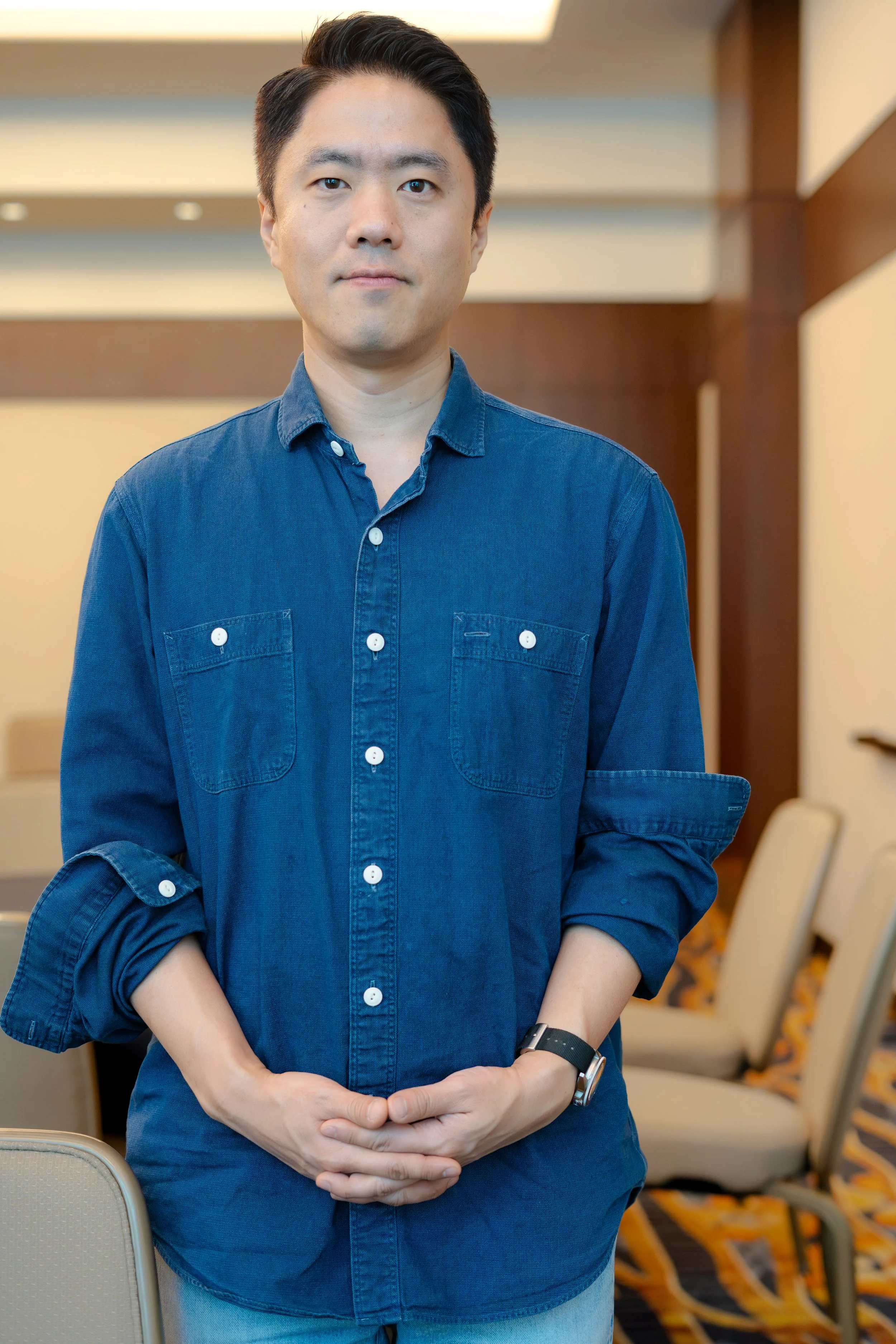
Otakon, Washington, D.C. August, 2025
Jong Hoon Chae is a music publisher and founder of Plum Tree Songs.
Ryuuza Media: So you are a publisher, master recorder, licensor, and you also founded Palm Tree Songs.
Jong Hoon Chae: To be very accurate, it's fair to label myself as a music publisher. Because master recorder implies that it's a record label. And licensor is also something that you use for third party usage for music IPs. So I think it's better to just put it as music publisher.
RM: Music publisher. Okay, sure. And so what is your role at Palm Tree Songs?
JHC: Well, I founded the music publishing company. So primarily, I am administering music copyrights, and primarily K-pop. And labels usually ask music publishers or writers, they are looking for a certain type of song. I sales pitch for that for creators, writers, producers, or publishers, whoever wants me to pitch their clients songs and stuff. And once I get a song placement, that's when the writers and everybody gets involved in terms of sending over the files to record labels for them to record for their acts, and sending over the credits for them to put it on the CDs and all that, and properly register the songs worldwide. That's the whole job that I do.
RM: And as a publishing and production company, what does Plum Tree Songs do?
JHC: In terms of music publishing, just what I said, administering music copyright and also play songs, new songs with K-pop labels. That's what I do as a music publisher. And in terms of production company, the production tasks, when I place a song with a label, normally the labels do a production deal. And on behalf of the creators that I work with, I handle the production agreement. So they are the usual production related tasks that I do, handling the legal side of it, and also handling the production tasks. Like sending over the files and see if there's any missing files and stuff for them to record.
RM: Some of the artists that you work with with Palm Tree Songs are Suho of Exo, Chung Ha, Key of Shinee, and Cravity, right? So going back, you've had a love for music, such a love for music that you actually went to college for it and studied music business at Columbia College, Chicago. What drove your passion and why did you choose music business?
JHC: I was studying business administration first, and then before entering the last semester, I decided to do something that I love. And that's how I got to know that there is music business course in the United States. Back then it was more than 6 or 7 years ago. Korea didn't have any music business related bachelor's degree-ish schools for offering that program. So that is the reason why I decided to go to Chicago as they have more affordable tuition fees compared to the ones in LA and New York. So that's why I went to Chicago to study music business.
RM: And who are your musical influences?
JHC: I'd say U.S. indie pop like Elliott Smith, Jeff Buckley, some of the minty fresh or soft pop records artists, like Portoise, and labels like Phil Jockey records. The indie pop in general in the U.S. really triggered my interest in music. So those are my favorite genres that I consult.
RM: So one of the things that you worked on, the Beatles weren't released on iTunes until November 2010 in the U.S. and you were part of the promotion campaign for the digital launch in Korea while working as marketing manager for Universal Music Group. But what roles did you play during this huge event? That had to have been quite the experience. I vaguely remember when the Beatles actually released that because there were certain things that weren't released that everybody wanted, like Tool. Tool didn't put out their stuff because they were like, oh, we don't want individual songs. We want people to experience the whole thing, the whole album.
JHC: It was 2015. But that's when, the Beatles' estate allowed their records to be out on streaming websites like Spotify. Korea came in a little bit later because Spotify and some other digital service providers, they weren't that active in Korea. Also, Apple Music wasn't a thing in Korea back then. So they had to negotiate with Universal Music.
And that was such an awesome experience because we could get as many product placement and promotion as possible from the label because if you're a DSP and you don't have Beatles, then it's like you don't have the classics of classics. So we got all the product placement online,the first flow case and promotional sites that were dedicated to Beatles releases and all that. It was a great pleasure to be working on that project.
As a market manager, I worked closely with the sales team, digital sales team, since they were the one who were the initial contact with the digital service providers. But it was me who had to get the approval from Universal Music's headquarter for what the DSPs want to do, which is the digital service providers, and do a lot of marketing campaigns with them to successfully launchthe digital campaign in Korea. Since as a marketer, I had to promote that news to the general music fans. So that was what I was doing.
RM: And a few years after that, in 2018, separate from that, you co-founded Musikade, which is a music publishing company, which had 10 songs on Spotify with over 100 million streams, and has also now sold over 10 million physical units. And there you were vice president of publishing and intellectual property, working with A&R artists in repertoire and creative licensing. Could you talk about those responsibilities and working with various artists?
JHC: I was working with a producer called Ryan Jeon. He is one of the well-known producers in K-pop. The way how we work is to collaborate with a lot of songwriters. And Ryan Jeon and myself and other of my co-workers, we as a music publisher, for us to bring revenue to the table, we have to do a lot of sales pitch with labels. And Ryan Jeon, he placed a lot of songs with SM and other labels, but I also did a lot of placements with them. We all collectively placed a lot of songs in the K-pop industry, and that's the result of what you just addressed.
RM: And how did you shift into Plum Tree Songs?
JHC: I think it was the right timing for me to make an independent company of my own. So it was just the right timing, again, to start my own company. So after working five years at Musikade, that's why. It's been a little bit over two years and seven months that I started working, and I'm still enjoying the life.